In this guide
A focused discrepancy, a bounded request, and carefully chosen evidence make an administrative question easier to investigate.
Describe a difference before naming its cause
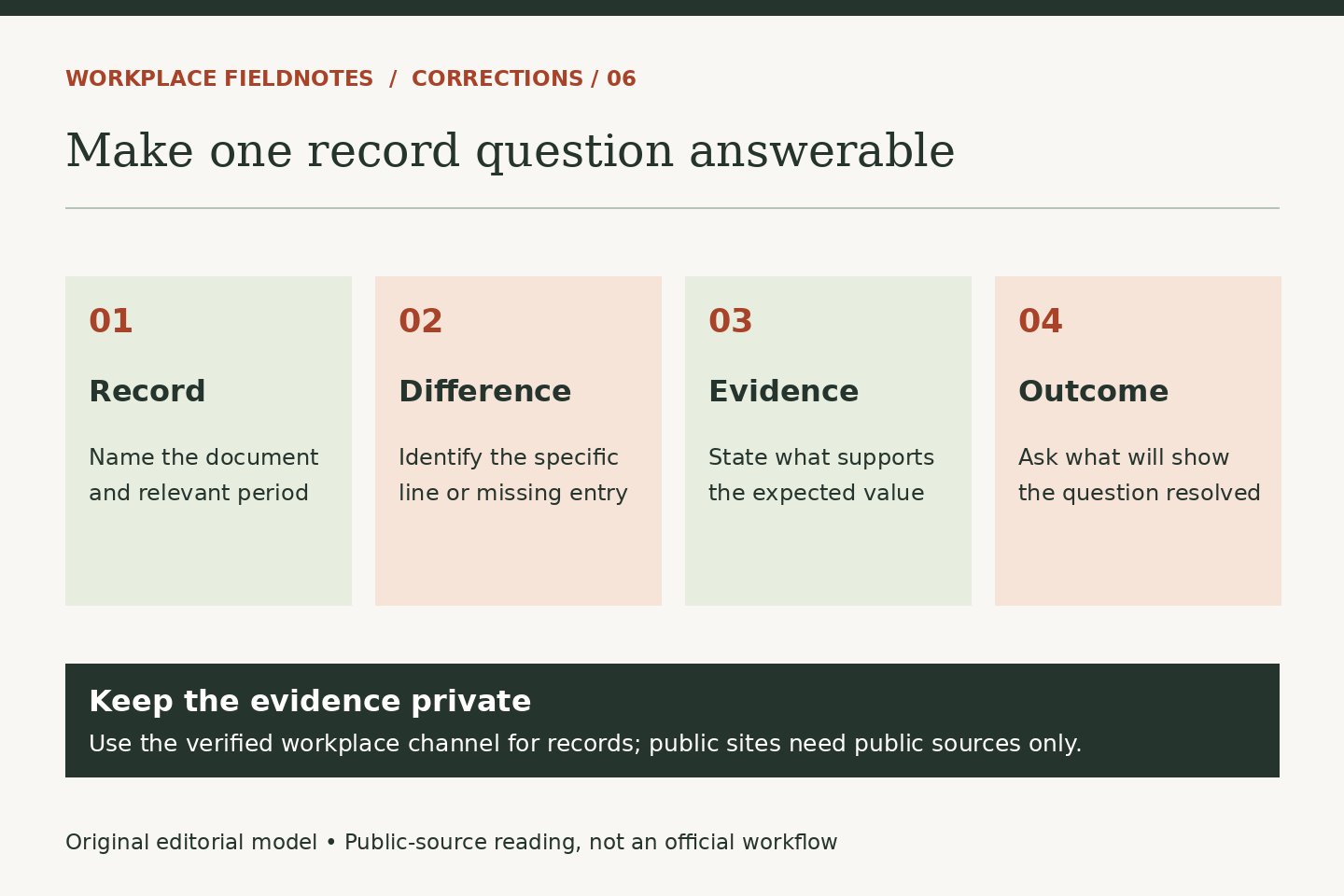
An employee record looks wrong. The first impulse may be to explain how the mistake happened, but the more useful starting point is what you can actually observe. Name the record or field, the relevant date or period, what it currently shows, and what you expected it to show. A discrepancy can be investigated without requiring the recipient to accept your theory about its cause.
Keep the question narrow enough to answer. A missing entry, an unfamiliar label, and an unexpected total may be related, but they are not automatically the same issue. If you combine them into a long account of every previous frustration, the person reviewing the message must first reconstruct the question. Give the most consequential discrepancy its own clear sentence and keep background in a separate paragraph.
Use evidence that fits the question
For a time or pay question, distinguish a schedule from a record of time actually worked and from a payment record. The Department of Labor's recordkeeping guidance discusses records of hours and wages, and its worker-facing guidance encourages workers to keep their own hours record. That makes dated, factual notes useful context. It does not establish how a particular employer will investigate a discrepancy or guarantee a particular outcome.
Describe what evidence you have before sending a large attachment. A relevant date, the name of a document, and the entry you are questioning may be enough to begin. If someone needs a copy, confirm the authorized channel and share only what is necessary for that question. Do not forward a whole folder because one page is relevant, and do not alter original records to make a comparison look cleaner.
Ask for an explanation or a defined next step
A concise request could read: 'The record for the period ending [date] shows [entry]. My dated notes show [different entry]. Could you explain how this field is determined and whether it needs review? Please let me know what supporting information is needed and the approved way to provide it.' Replace the placeholders only in an appropriate private channel. This is a general writing example, not an official Tenet form or a statement of its internal process.
If you already understand the field and are requesting a correction, say precisely which entry you believe should change and why. Avoid asking for a blanket adjustment when the evidence supports only one item. Where timing matters, state the real deadline and its practical effect. Ask who owns the next step and when an update is expected, while recognizing that this article cannot promise a response time.
Keep a clean record of the conversation
After sending the question through a verified employer channel, retain the date, the request, and any reference number in a safe place. On follow-up, refer to the original question and add only the new evidence or unresolved point. This helps distinguish a genuinely unanswered request from a new issue that happens to involve the same system. If an explanation resolves the difference, note the explanation rather than continuing to describe the entry as an established error.
Questions involving disputed wages, legal rights, or a consequential deadline may need qualified advice beyond routine correspondence. This article offers a communication method, not legal advice or a replacement for official reporting routes. The practical aim is modest: make the question understandable, preserve relevant facts, protect unrelated information, and identify a next step that someone can actually take.
Read next: From Scheduled Shift to Paid Hours: What Records Can Explain, or Keep Patient and Employee Information Out of Public Support Searches.