In this guide
A hospital name, a corporate parent and a company serving that hospital can all appear in one career story. Knowing which relationship each name describes makes the details easier to verify.
One workplace can have several names
A healthcare workplace can be introduced by the name on its building, the name in a recruitment advertisement and the name on an employment document. Those names may be related without being interchangeable. For a candidate, the distinction becomes practical as soon as a question concerns the offer, a benefit, a reporting relationship or a transfer. A corporate family tree is useful background, but it cannot replace identifying the entity responsible for a particular employment decision.
Tenet provides a good example of why this matters. The enterprise includes care delivery and support businesses, and its public materials describe them for different audiences. This map uses official sources reviewed on October 1, 2026. It explains those distinctions without claiming that every facility follows one employment policy or that a shared corporate connection guarantees identical working conditions.
A dated snapshot of the organization
Tenet's June 30, 2026 Form 10-Q identifies two reporting segments: Hospital Operations and Services, and Ambulatory Care. At that date, it reported 50 acute care and specialty hospitals and 135 outpatient facilities in Hospital Operations. USPI, the Ambulatory Care business, held interests in 538 ambulatory surgery centers and 26 surgical hospitals. The filing places Conifer's revenue cycle and value-based care services within Hospital Operations and identifies Conifer as wholly owned.
These are dated reporting facts, not a live directory or a count of identical workplaces. In particular, an ownership interest does not mean every facility is owned outright. USPI's own public description emphasizes partnerships with physicians and health systems, including three-way joint ventures. A local center can therefore have a distinct identity while participating in a much broader surgical network.
Tenet's general business overview separately presents USPI, hospital operations, Conifer and the Philippines-based Global Business Center. That public-facing grouping should not be confused with the filing's financial reporting segments. Different maps can be useful for different purposes, but their labels need to travel with them. Calling every named business a separate financial segment would erase an important distinction.
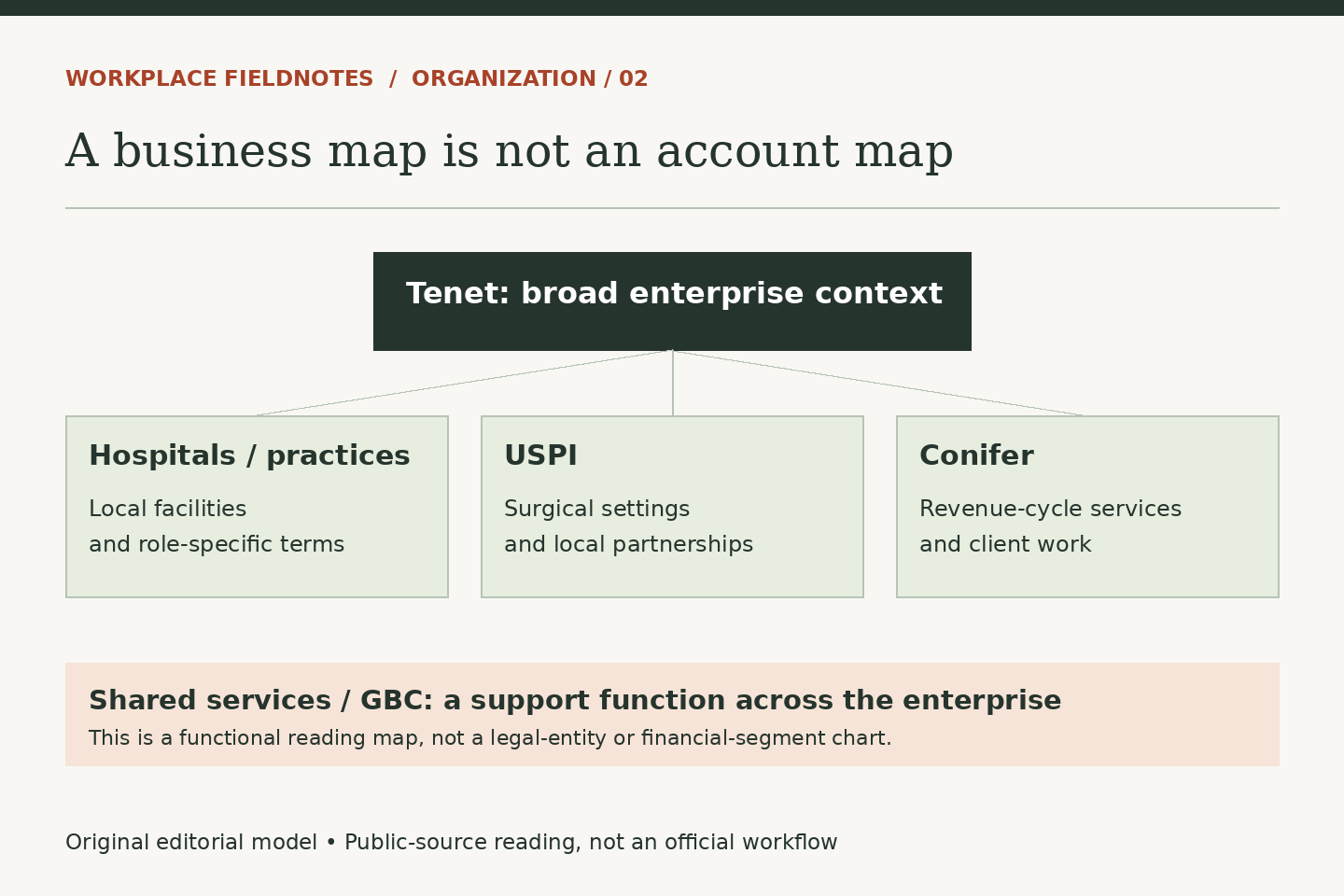
Care delivery and support are connected work
A hypothetical candidate considering a hospital role and a patient-account role might describe both as working in healthcare. That is true but incomplete. The first comparison to make is the actual function: what work reaches the person, what decisions they own, what a completed task looks like, and who depends on it. A broad industry label cannot answer those questions, and a familiar facility name may not reveal the employing organization.
Conifer's careers page describes work in patient access, patient accounts and clinical revenue integrity. Those categories help a reader form better questions about the daily role. They do not establish the conditions of an individual opening. For example, a candidate can ask whether a specific position involves direct patient conversations, account resolution, documentation review or a combination. The answer should come from that job's current description and hiring team.
This functional view also avoids a false hierarchy in which only bedside work counts as healthcare work. A reader can recognize the importance of administrative and technical contributions while still asking how performance is assessed and how problems are escalated. Respect for the work and scrutiny of its employment terms belong together. Neither requires accepting recruitment language at face value.
Ownership changes require careful verbs
On February 2, 2026, Tenet announced that it had resumed full ownership of Conifer, with the equity change effective January 1. Its release also described a transition in Conifer's relationship with CommonSpirit, with services expected to conclude by the end of 2026. An ownership change and a client-service transition are different events; neither statement, by itself, describes what happens to a particular employee.
That is where careful verbs matter. A company can own another business, operate a facility, partner with physicians or provide services to a client. Replacing all of those relationships with belongs to may make a sentence shorter while making its meaning worse. Before drawing a conclusion about a job, identify which relationship the source actually establishes, when it applied and whether the role in question is connected to it.
A hypothetical worker who hears about a corporate transaction should therefore seek a role-specific answer rather than infer personal consequences from the headline. Which entity will employ them? Has their reporting line changed? Does any written notice address their position? Public reporting can reveal a question worth asking. It cannot supply an individual employment outcome that the evidence does not contain.
A better way to compare two opportunities
Imagine two hypothetical openings with similar titles, one at a hospital and another at an affiliated surgical center. Start by recording the employing entity and work location separately. Then compare the substantive work, the agreed schedule and the written compensation terms. If the opportunities use different benefit descriptions, ask for the documents applicable to each position rather than assuming that a corporate connection makes them equivalent.
An internal move deserves the same care. A larger network can make another role visible; visibility alone does not answer how service credit, unused leave, eligibility dates or onboarding will be handled. These are questions to resolve with the responsible team before relying on a transfer assumption. The purpose is not to predict a negative outcome. It is to avoid treating an unanswered detail as an agreed term.
Keep the map attached to the decision
The employer name matters most when it points to responsibility. It helps a candidate locate the right offer, helps a worker direct a question and helps a reader avoid borrowing facts from a different part of the enterprise. The broad Tenet name remains useful context, but the practical unit of understanding is the particular role and relationship.
Read corporate sources for the structure they document. Read the current posting for the opening it describes. Ask the authorized hiring or workplace team about the terms that affect you. A good organizational map does not settle every question. It makes it much easier to see which questions still need an answer.
Read next: How to Read Tenet's Public Footprint Without Mixing Dates, or Why a Revenue-Cycle Role Is Not the Same as a Hospital Unit.