In this guide
Keep requirements, trade-offs, and unanswered questions visible instead of hiding them inside one attractive number.
A single score can hide the deciding fact
Two healthcare jobs can look close on a comparison sheet and feel very different in daily life. A higher salary may arrive with a schedule you cannot sustain. A shorter commute may not compensate for missing a required qualification. If you combine every factor into one score, you can accidentally allow several small advantages to cancel a condition that was never negotiable. The arithmetic looks precise while the underlying choice becomes less clear.
Start by writing a short description of each actual opportunity, including the role, location, employment status, and source date. Comparing a specific offer with a generic occupation is unfair to both. An occupation describes a broad type of work; an offer proposes particular terms. Put the two options on the same evidentiary footing before deciding which details deserve the most attention.
Separate gates from preferences
First identify gates: requirements that must be satisfied before the role is a realistic option. Examples include a required credential, a feasible start date, and a schedule that meets an essential personal constraint. Mark each as confirmed, unresolved, or not met. Do not award extra points elsewhere to make an unresolved requirement disappear. If a vacancy is unclear, the next task is clarification rather than ranking.
Then identify preferences: features on which you can genuinely trade. These might include commute, type of collaboration, opportunities to develop a particular skill, or the balance between different kinds of work. Describe why each matters to you. 'Predictable evenings for an existing commitment' is more useful than a vague preference for work-life balance because it can be tested against an actual schedule.
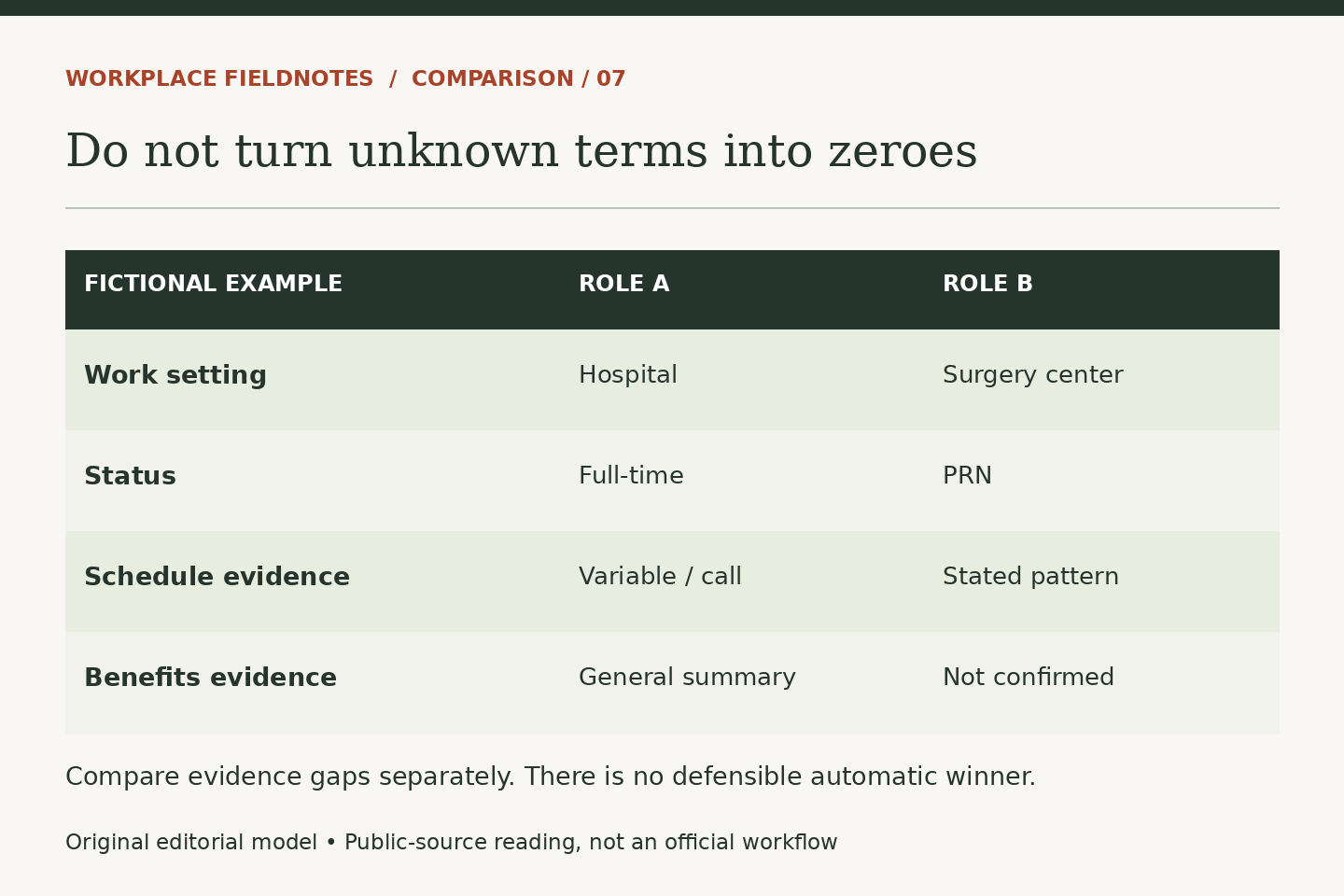
Compare evidence at the right level
The BLS profiles of registered nurses and medical records specialists illustrate how differently healthcare occupations can be structured. One centers on providing and coordinating patient care; the other centers on patient files and related information work. These broad descriptions help establish occupational context. They cannot tell you the duties, pay, or working arrangement of a particular opening, and neither occupation should be treated as a shortcut into the other.
For benefits, record eligibility and applicable terms rather than copying the most appealing headline. Tenet's general programs page states that eligibility depends on employment status and that career-growth benefits vary by facility. Use that as a reason to ask role-specific questions, not as a promise of a package. Keep quoted base pay, conditional incentives, and estimates in separate lines so a best-case assumption does not quietly become the expected outcome.
Make the uncertainty part of the result
For each important factor, keep three short notes: what you know, where it came from, and what remains unanswered. A comparison with visible gaps is more useful than one filled with guesses. If one unresolved point would change your decision, ask about it first. You do not need equal amounts of information about every feature; you need reliable information about the features that could change the choice.
End with a sentence rather than a winner's badge: 'I currently prefer this role because these confirmed conditions fit my priorities, provided this remaining question is resolved.' Then test the conclusion. Would it change if an incentive were unavailable or a shift differed from your assumption? A sound decision can survive that challenge. A fragile one tells you exactly which fact to verify before accepting.
LOCAL READING TOOL / NO ACCOUNT DATA
Two roles. Better questions.
Compare the evidence behind two healthcare roles. Choose broad categories only: the result is a question plan, never a ranking, eligibility decision or employment recommendation.
No names, pay amounts, uploads or submission. Choices stay in this page’s memory; this tool does not use cookies, browser storage or URL parameters. Your browser may independently restore form state.
Read next: Read a Healthcare Job Posting Before Comparing the Offer, or How to Read a Benefits Summary Without Assuming Eligibility.