In this guide
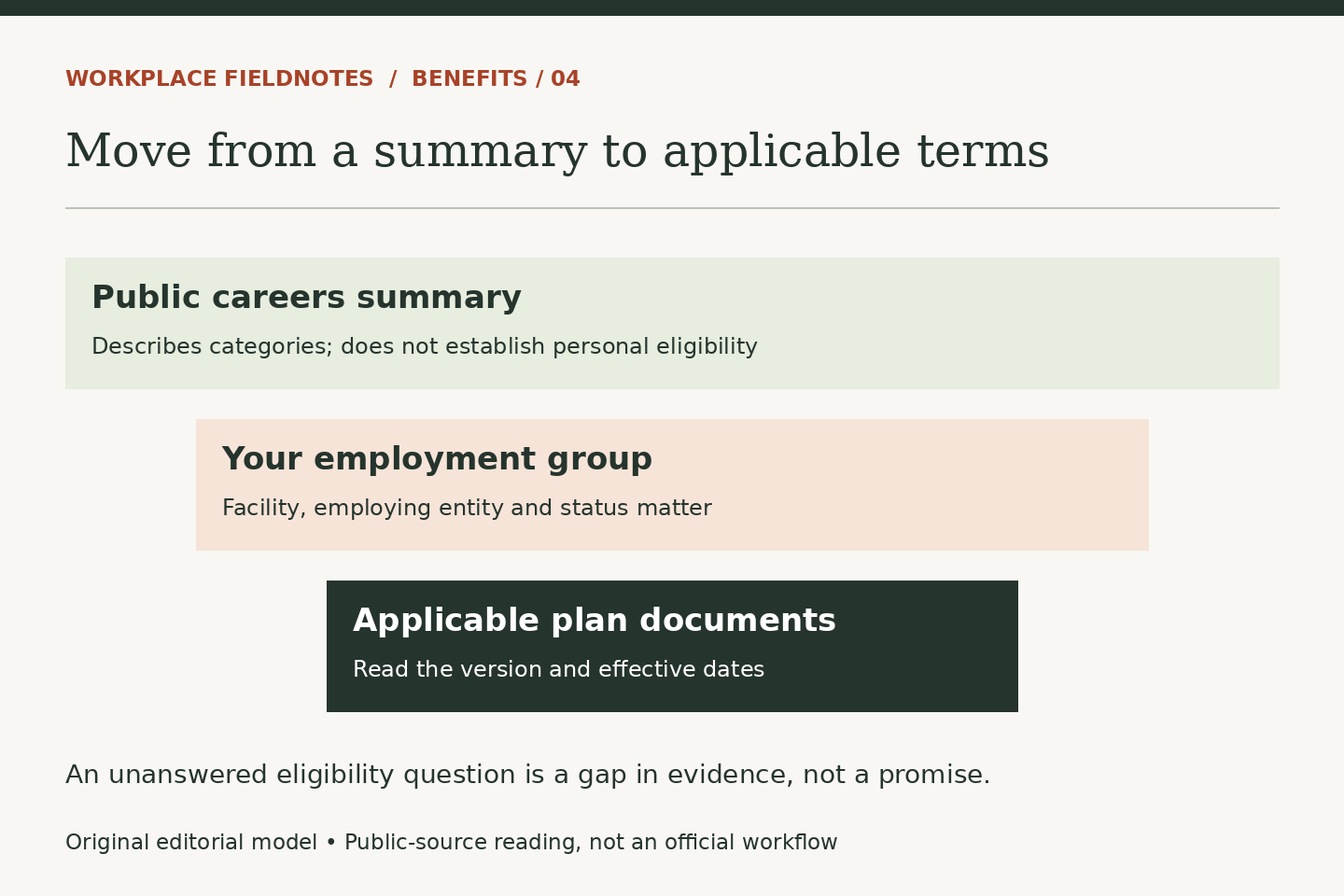
A benefits brochure describes possibilities. Your employment category, applicable plan documents and confirmed enrollment answer a different set of questions.
Begin with the document’s job
A benefits summary is useful precisely because it leaves things out. It gives a reader a manageable view of a much larger arrangement. Trouble starts when that overview becomes a promise about one person’s coverage. Tenet’s public Programs & Benefits page lists broad benefit categories and says eligibility depends on employment status. That statement is a reason to investigate your own situation, not a shortcut to deciding it.
Before comparing costs, write down the document’s title, year and intended audience. Is it a recruiting brochure, a health plan’s Summary of Benefits and Coverage, an enrollment confirmation or an explanation addressed to a particular employee group? A document can be accurate and still answer the wrong question. A page describing available programs does not, by itself, establish that you have enrolled in any of them.
Build a small evidence packet
The Department of Labor distinguishes a Summary Plan Description, which explains a plan and its operation, from a Summary of Benefits and Coverage, which summarizes important coverage and cost-sharing features. Neither name should be used as a catchall for every benefits document. Identify the applicable plan and year, then request the documents that address the question you actually have.
Keep your role or status confirmation beside those documents. Add an enrollment confirmation if one exists, including its effective date. These records serve different purposes: a plan document describes rules, while a confirmation records a particular election or outcome. If one item seems inconsistent with another, preserve both and ask the responsible benefits contact to reconcile them. Do not quietly replace the older record or assume the more attractive description wins.
Hypothetical example: the attractive overview
Imagine that Morgan accepts a part-time role and reads a public page mentioning medical coverage and education support. Morgan’s offer identifies the position, but the benefits packet has not arrived. The reasonable next step is not to budget for either benefit as a certainty. Morgan asks which programs apply to that position, which documents govern them, and what action or deadline is involved.
Suppose Morgan later receives a medical-plan summary dated for the previous year. That does not establish that coverage is unavailable; it establishes a document question. Morgan asks for the version applicable to the anticipated coverage date. This separates three uncertainties that otherwise become tangled together: whether the role qualifies, what the current plan provides, and whether the enrollment process has been completed.
Ask for a determination you can use
A useful inquiry names the employer or business unit, position status, relevant date and exact document passage. For example: “My offer identifies this role as part-time. Which current benefits materials apply to it, and where can I confirm the coverage effective date?” Keep health details out of an initial administrative question unless an authorized recipient explains why they are necessary.
Tenet hospitals, USPI facilities and Conifer roles should not be treated as interchangeable employee groups simply because they appear within a larger enterprise. Ask the contact responsible for your actual position. Save the response with its date and any referenced document. An independent editorial article can help you organize these questions; it cannot decide eligibility, confirm coverage, or replace the applicable plan materials.
Read next: Full-Time, Part-Time and PRN: Read the Actual Posting, or What to Ask Before Moving Between a Hospital and Surgery Center.