In this guide
The useful details in a posting are often separated by recruitment copy. A real Tenet nursing advertisement shows how to distinguish a published range from the terms you need in an offer.
A posting is evidence, not the whole agreement
The first number in a healthcare job advertisement is easy to remember. The employment status, shift, eligibility language and qualifications may be less prominent, even though they determine whether that number is useful. Reading a posting well means restoring those details to the same frame. The goal is not to turn every application into a negotiation. It is to know what the advertisement answers and what still needs to be established before comparing opportunities.
This article uses an employer-published Tenet listing as a reading example, checked on October 1, 2026. A page being publicly retrievable does not prove that the opening is still accepting candidates. The example is specific to its advertised role and location; it is not a wage benchmark for the enterprise or a prediction of what any applicant will receive.
The details that change the comparison
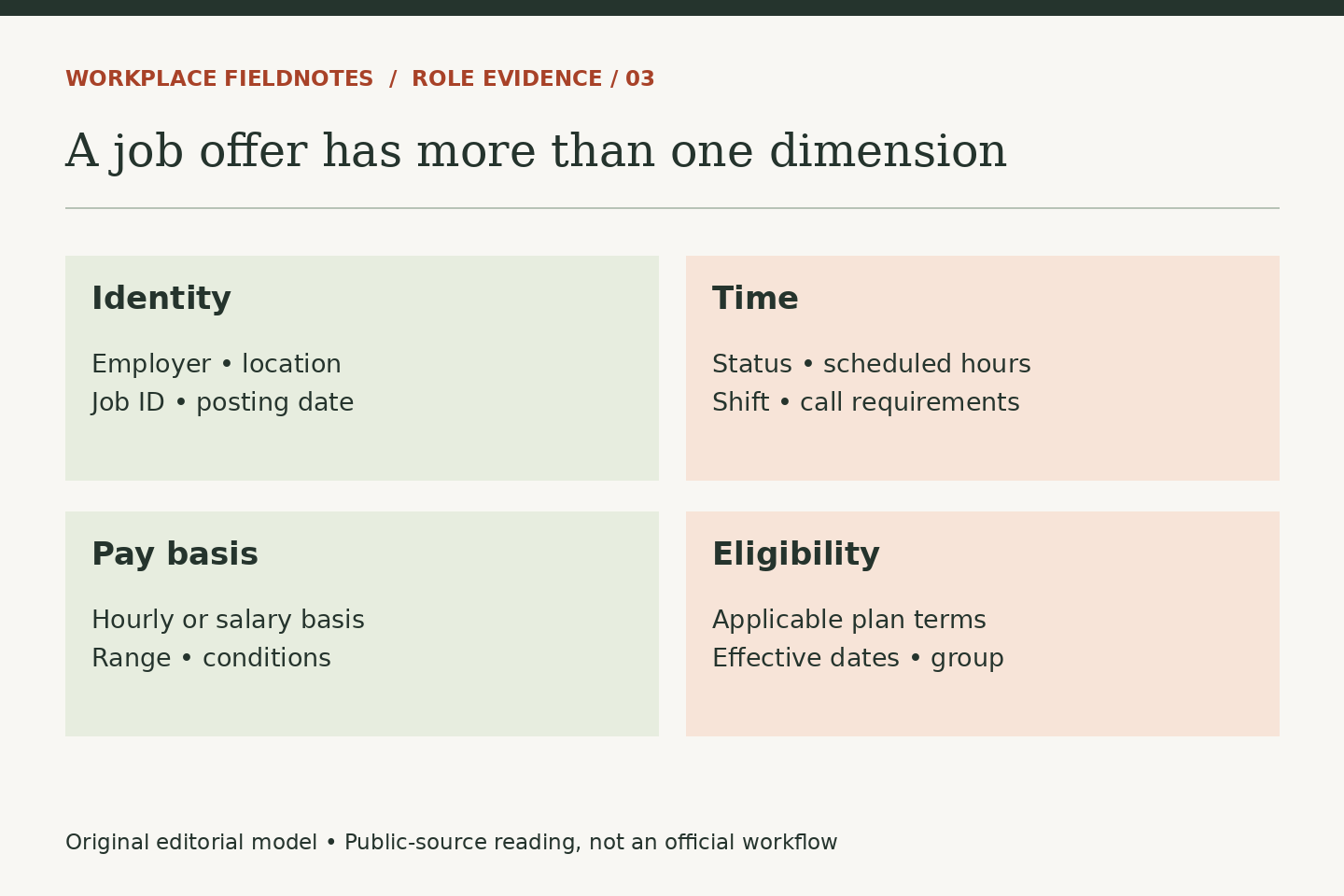
The listing is Registered Nurse (RN) – ER in Town of Framingham, Massachusetts, requisition 2503007585. It identifies part-time evenings and gives an hourly range of $33.50 to $73.31, with individual wages dependent on factors including qualifications and experience. It advertises a sign-on bonus of up to $10,000 based on eligibility. Its qualifications distinguish required nursing education and professional credentials from a preferred academic nursing degree.
Those facts describe several separate dimensions: the work, its location, the time commitment, the pay unit and conditions attached to additional money. Combining them into a single headline salary loses information. Equally, seeing a preferred qualification does not answer how strongly it will be weighted in this hiring decision. A candidate should preserve the distinction between a requirement, a preference and a term that still needs confirmation.
A useful first reading produces a short factual note in the reader's own words, with the source URL and date. On the second reading, add questions rather than guesses. How many hours are scheduled? What does the advertised shift mean in practice? Which compensation elements apply to this position? The point is to arrive at a recruiter conversation with uncertainty clearly located.
Compare time before annualizing money
Consider two entirely hypothetical offers unrelated to the published listing: one pays $40 per hour for 24 scheduled hours each week, and another pays $38 for 36. Assuming the same schedule for all 52 weeks, the simple gross-pay illustrations are $49,920 and $71,136. Those figures exclude overtime, unpaid time, differentials, bonuses and deductions. The lower hourly figure produces the larger annual illustration because the promised time commitment is larger.
That arithmetic does not identify the better job. Twelve additional scheduled hours each week may change childcare, commuting, study time or recovery between shifts. Conversely, a person seeking more dependable income may value the larger schedule. The comparison becomes useful only after the hours are explicit. Treating the first offer as superior because its hourly rate is higher would answer a question the candidate has not actually asked.
For an uncertain or variable schedule, use a range of hypothetical hours rather than one confident annual number. A conservative scenario can show what happens if fewer shifts are available. A higher-hours scenario can expose how much extra work the appealing total assumes. Label the assumptions clearly; do not quietly import a forty-hour week into a role that has not promised one.
Keep one-time money on a separate line
A bonus and a recurring wage can both matter without doing the same job in a household budget. In a hypothetical comparison, a $6,000 payment may make the first year look attractive while leaving later years unchanged. Its usefulness also depends on when it is paid and what conditions accompany it. Before relying on it, ask for the written eligibility, payment schedule and any repayment terms that apply to the actual offer.
Avoid spreading a conditional bonus across every working hour as if it were a permanent raise. That presentation can hide both timing and obligation. Instead, compare recurring compensation on its own and then consider the additional payment under its stated conditions. If an important condition remains unanswered, leave the amount unresolved rather than counting the most favorable interpretation as money already earned.
Benefits deserve a similarly concrete treatment. A general benefits page can introduce the categories an employer promotes, but a decision depends on the applicable plan, eligibility date, employee cost and coverage relevant to the person. Ask for the materials for the offered role and employment status. A familiar benefits label is not enough to establish identical terms across two opportunities.
Turn culture language into a better conversation
Tenet's careers homepage publishes a testimonial attributed to Becky M., a director of emergency services, emphasizing teamwork and its visibility to patients. That is an employer-selected voice, not an independent survey or our interview. It can still suggest a useful subject to explore: what does collaboration look like during a difficult shift in the specific team considering the applicant?
Ask for an example of how the team handles an unfamiliar task, how a new colleague gets feedback or how concerns reach the appropriate person. Concrete examples are easier to assess than another broad promise of support. Listen for the division of responsibility as well as the positive language. A discussion of who helps, when and through which process is more informative than a slogan alone.
The final comparison should survive in writing
By the offer stage, the candidate should be able to describe the role without borrowing assumptions from another advertisement. The recurring rate, expected hours, location, employment status and any conditional payment should fit together. If a recruiter resolves an ambiguity, ask where that resolution appears in the offer or supporting material. This is a request for clarity, not an accusation of bad faith.
The best reading of a job posting ends with fewer invented details. It preserves what the employer actually published, tests the assumptions behind the attractive numbers and directs unresolved questions to the people authorized to answer them. That is a stronger basis for a career decision than either uncritical enthusiasm or automatic suspicion.
Read next: Compare Two Healthcare Roles Without a Misleading Single Score, or Full-Time, Part-Time and PRN: Read the Actual Posting.