In this guide
A useful way to understand eTenet starts outside the sign-in screen: separate the organization, the workplace, the task and the access route before drawing conclusions.
The name is a starting point
A person searching for eTenet may be trying to understand a new employer, return to a job application or resolve a workday problem. Those are different needs, even when a search engine places their answers together. The first useful question is therefore not which button to press. It is what relationship the person has to the organization, and what they are trying to accomplish. A public explanation can help sort those questions without pretending to see the employee's account.
This article maps the public-facing context reviewed on October 1, 2026. Workplace Fieldnotes is an independent publication, not Tenet's support service. We have not entered restricted systems or verified private menus. The distinction matters because an attractive diagram of an imagined employee dashboard would create confidence without evidence. A better map shows what public sources establish and leaves the rest explicitly dependent on the person's workplace.
What the public pages actually show
Tenet's corporate website includes an Employees link to secure.etenet.com. Opening www.etenet.com during our review led to a secure eTenet sign-in address. Separately, the careers homepage displayed Current Employees and Returning Sign-In links to Oracle-hosted destinations. These are observations of public links, not proof of a single universal access path or a description of the services available after authentication.
That limited evidence is already helpful. It tells a reader to distinguish a corporate employee entry point from a recruiting workflow. It does not establish that every person associated with Tenet uses the same account, that a new hire's access is active, or that one successful sign-in grants entry to every work application. The page label describes an intended audience; the employer determines the individual's authorization.
Four layers that are easy to collapse
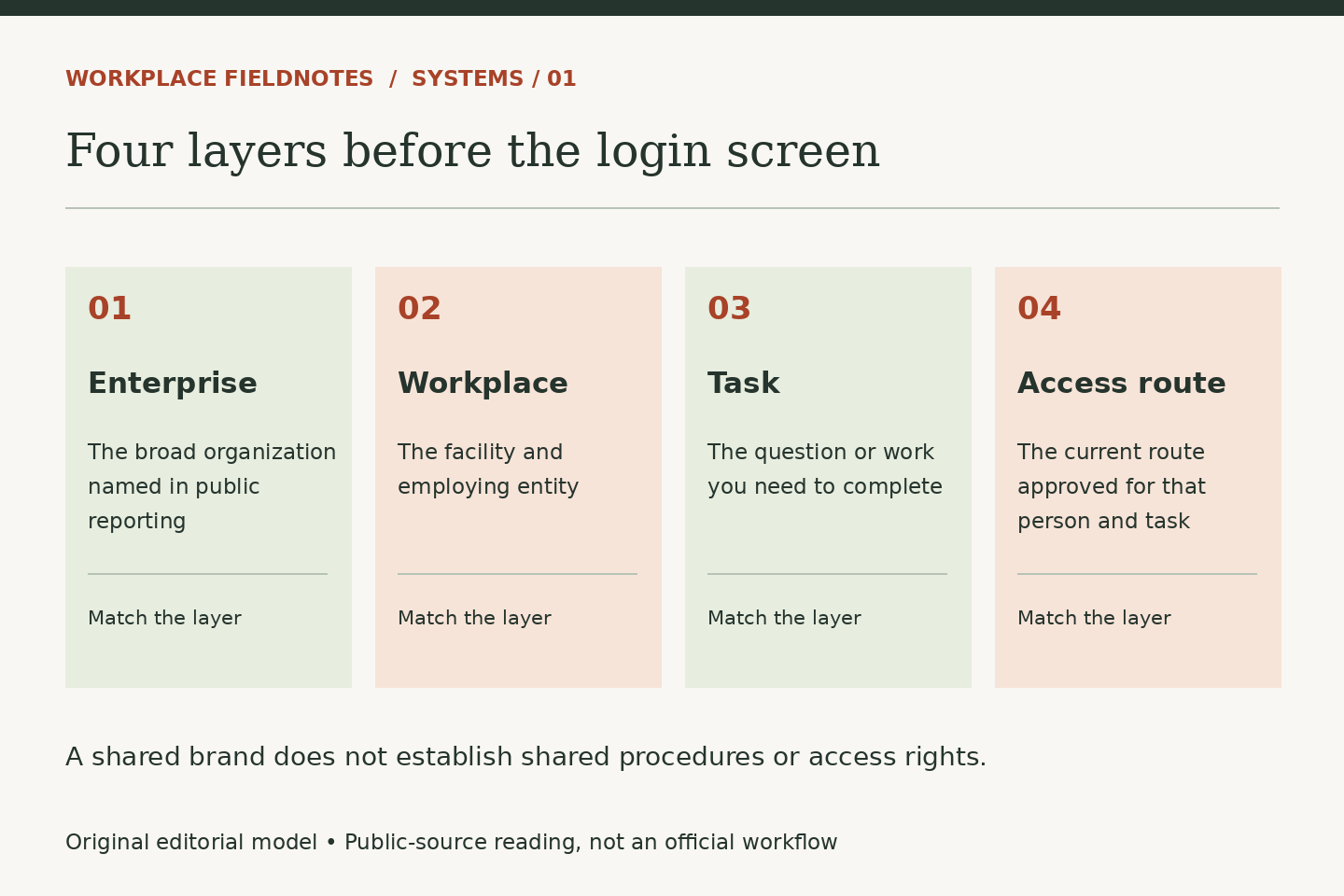
Think of a workplace system as four overlapping layers. The enterprise is the broad organization whose name appears in public communications. The workplace is the particular facility, employing entity or business unit. The function is the work being performed, such as applying for a role, completing an assigned administrative task or obtaining an approved document. The access route is the employer-provided way to reach the relevant service. These layers are an editorial model, not a diagram of Tenet's technology architecture.
Tenet's public business overview describes hospital operations, USPI, Conifer Health Solutions and the Global Business Center. That variety makes the layered model more useful than a list of supposed portal features. Someone can belong to the same broad enterprise as a colleague while working in a different business, country, facility or role. The shared name is context. It is insufficient evidence that the two people have interchangeable procedures.
The layers also explain why a technically correct answer can fail in practice. An answer about the right company may still describe the wrong employment relationship. An answer about the correct relationship may address the wrong task. Even an accurate task description may be outdated if its route has changed. Precision comes from matching all four, rather than treating the brand name as the complete specification.
Access and responsibility are different questions
Consider a hypothetical new hire who can open a recruiting account but has not received workplace instructions. It would be a mistake to interpret that success as proof that their employee access is ready. The appropriate next question is who owns the unfinished step: recruiting, local onboarding, a manager or the designated support team. The example illustrates a general distinction between an application record and an employment process; it does not describe a verified Tenet onboarding sequence.
Now consider a hypothetical established employee who reaches an approved application but sees no expected document. Authentication, permission, publication timing and document ownership are separate possibilities. Repeatedly changing account settings would be a poor substitute for identifying which question needs an answer. A concise support request can state the work task, the approved route used, the visible result and the time it occurred, without including passwords or personal records.
This is also a privacy boundary for independent publications. A guide can explain categories of problems. It should not ask readers to send screenshots containing patient information, compensation records or identity details to prove what happened. The most useful troubleshooting evidence belongs with the authorized workplace support channel, where the people responsible can assess it in context.
Read the age of the evidence
A search result can survive longer than the process it once described. Public pages may serve different audiences and may be updated on different schedules. A dated corporate filing, an undated navigation link and a cached job advertisement answer different questions. None should be promoted into a timeless description of a private employee environment. The date attached to our review is a limit on the reporting, not a guarantee about tomorrow's screen.
For the reader, that means keeping a small distinction between an observed fact and an inference. Observed: an official corporate page links to a particular employee destination. Inferred: this must be the right route for a specific worker's current task. The first can be documented publicly. The second may require instructions from that worker's employer. Writing the inference down as a question prevents it from quietly becoming an assumption.
A map should reduce the next question
The practical value of this map is a narrower conversation. Instead of asking what eTenet does in the abstract, a reader can ask which official resource applies to their workplace and purpose. Instead of expecting a public article to diagnose private access, they can describe the unresolved step to the person responsible. Less guessing is a meaningful improvement, especially when the alternative is entering information into a site chosen only because its name looks familiar.
eTenet belongs in the public story of Tenet's workplace, but it should not stand in for the whole story. The organization, the employment relationship, the task and its approved route all deserve their own space on the page. Keeping those distinctions visible makes an independent explanation both more useful and more honest.
Read next: Tenet Hospitals, USPI and Conifer: Why the Employer Name Matters, or Recognize the Boundary Between Editorial Help and Secure eTenet Access.