In this guide
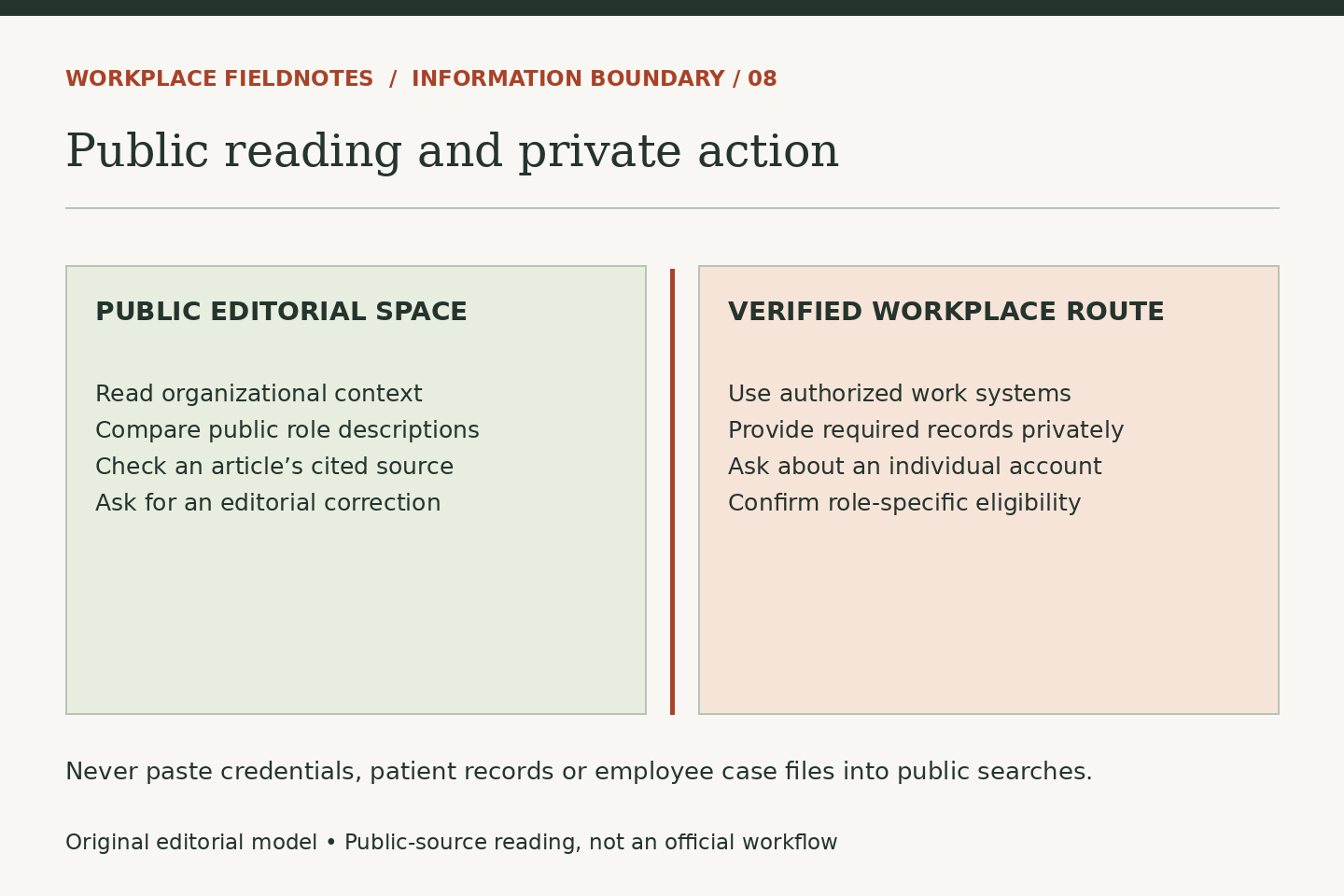
Search for the general problem in public. Reserve identifiable records and account details for verified, authorized channels.
A helpful search does not need the whole record
A puzzling screen can create a strong urge to paste everything into a search box. Resist that shortcut when the screen contains information about patients, coworkers, or your own employment. A public search should describe the category of problem, not reproduce the underlying record. The useful question is usually about a field, a browser behavior, or a general error message. Names, identifiers, and case details rarely make that public question safer or more answerable.
Treat search engines, public forums, and general-purpose support chats as separate destinations from an employer's approved systems. A tool being convenient does not establish permission to send work information there. This article is general privacy guidance. It does not authorize any transfer of workplace data or replace the policies and instructions that apply to your role.
Do not flatten every record into one legal label
HHS explains an important distinction: the HIPAA Privacy Rule does not protect employment records held in an employer capacity, even when they contain health-related information, while a worker's patient or health-plan records can be protected. That distinction is not permission to publish an employment record. It means that the applicable rules depend on the record and the context, rather than simply on whether the employer operates in healthcare.
HHS also describes the minimum-necessary standard for many uses and disclosures of protected health information and notes exceptions. It is not a universal formula that makes any disclosure acceptable once a name is removed. For a practical support question, begin with less information and obtain guidance through an authorized route when actual record details are needed. Do not attempt to decide a complex disclosure question from a search result alone.
Rewrite the question before sharing a screen
Compare 'the page returns a session-expired message after sign-in' with an image of the whole browser. The sentence communicates a technical symptom without exposing neighboring tabs, account names, or record content. Describe the action immediately before the problem, the generic wording of the error, and whether it happens consistently. Omit passwords, one-time codes, access tokens, patient details, and employee identifiers from a public request.
A screenshot deserves a separate review even if you believe you have hidden the obvious information. Look at headers, sidebars, notifications, filenames, address bars, and content visible behind a dialog. Avoid uploading the image to a public redaction service to prepare it for public sharing. If a screenshot is genuinely needed, use an approved method and destination. Cropping or obscuring a few fields does not by itself prove that a workplace record is safe to disclose.
If information was shared, stop widening the exposure
If you discover that a public post or support request included private information, avoid reposting it while asking what to do. Use the verified privacy or security reporting route available to you and follow its instructions. Preserve the facts needed to explain what happened without creating additional copies in unrelated services. Do not assume that deleting a visible post proves that every copy is gone.
For everyday troubleshooting, a useful boundary is simple: public research for general concepts, verified private channels for account-specific facts, and authorized systems for actual work records. This keeps the first question small and gives the appropriate team the chance to request evidence safely. Getting help and protecting information are compatible when you decide what to share before choosing where to paste it.
Read next: Recognize the Boundary Between Editorial Help and Secure eTenet Access, or Write an Employee-Record Question That Can Be Resolved.